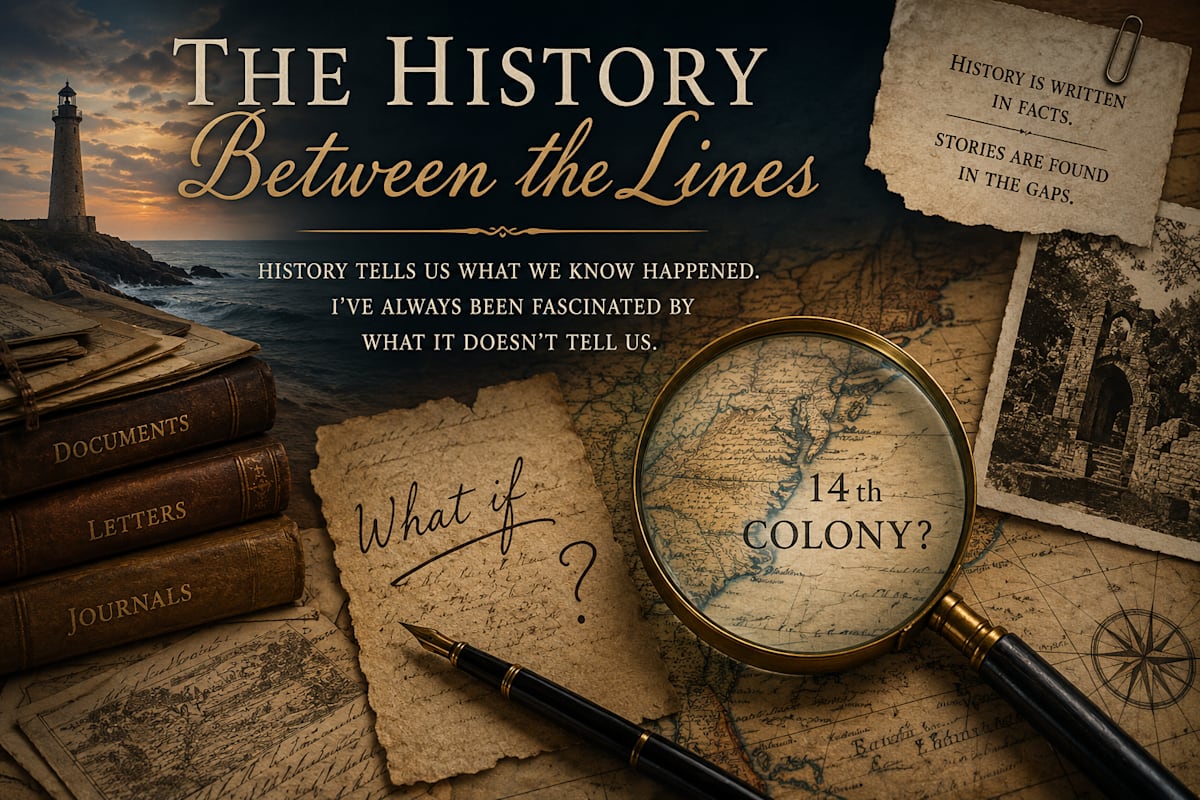
History tells us what we know happened.
I've always been fascinated by what it doesn't tell us. For as long as I can remember, I've had a vivid imagination. I've probably written hundreds of stories in my head that never made it onto paper. Most have long since disappeared. I have forgotten far more plots than I remember having.
The 14th Colony was different.
The idea stayed with me. In fact, the novel that eventually became The 14th Colony grew from two completely separate ideas that, for a long time, had nothing to do with one another.
The first began with two simple words:
What if?
I'm a longtime comic book collector, and one of the concepts I always enjoyed was Marvel's What If? series. Those stories stepped outside the established continuity of the Marvel Universe and asked what might have happened if something had gone differently. They weren't part of the mainstream storyline. That was the point. Writers were free to take something familiar, change one element, and follow the possibilities wherever imagination led them.
Somewhere along the way, that way of thinking followed me into history. One day I asked myself a question:
What if there had been fourteen original colonies instead of thirteen?
That immediately led to another question: If there had been a fourteenth colony, why don't we know about it?
And then another: What would have happened to it? Why would it have disappeared from the historical record?
And perhaps the most intriguing question of all:
What if the history we know was wrong?
Not wrong in the sense that everything we've learned should be thrown away. History doesn't work that way. But our understanding of the past is limited by the evidence that survives. Documents are lost. Settlements disappear. Archaeological discoveries reveal things that were previously unknown. A letter tucked away in an archive can change our understanding of a person or an event centuries after it happened.
I've always been fascinated when discoveries force historians to reconsider something we thought we already knew. That fascination grew when I read about evidence of an early settlement in North Carolina that seemed to appear and then disappear from the historical record. The circumstances were different from the story forming in my imagination, but the idea fascinated me.
Something could exist and then, for one reason or another, largely disappear from history. That was fuel for the fire. But I still didn't have Graham Hollingsworth.
That came from an entirely different idea.
The History Investigator
I began thinking about a character whose job was to investigate historical questions.
Not an archaeologist. Not exactly a historian in the traditional sense. Not a detective investigating crimes.
A history investigator.
Someone would bring him a seemingly small historical question. Perhaps an old document didn't quite make sense. A name appeared where it shouldn't. Two records contradicted each other. An artifact had an unexplained origin.
He would begin pulling at that tiny thread. One clue would lead to another. He would search archives, visit historical sites, examine old records and connect pieces of evidence that had existed independently for years, perhaps centuries, without anyone realizing they belonged together. And eventually he would uncover a historical truth no one had previously discovered.
I loved the possibilities. A character like that could have an almost limitless number of adventures because history has an almost limitless number of unanswered questions.
For a while, the history investigator and the fourteenth colony remained separate ideas.
Then one day the obvious finally occurred to me. Why not put them together? The mystery of the fourteenth colony could become the history investigator's first case.
Suddenly, I had the beginnings of a novel. I just needed to figure out who this man was.
What's in a Name?
Naming him turned into an adventure of its own. I had noticed something about popular fictional heroes. James Bond. Jason Bourne. John McClane. Jack Ryan. Jack Sparrow. There were an awful lot of J's. I initially thought I might follow that tradition, but instead I turned the whole thing into an exercise.
I started making names.
I created a list using consecutive letters of the alphabet for the initials: A.B., B.C., C.D., and so on. I worked my way through the alphabet, pairing first names and surnames and seeing whether anything sounded like the man I was beginning to picture.
Then I tried another old comic-book tradition: alliteration. Peter Parker. Lex Luthor. Clark Kent, at least phonetically. There is something memorable about names with that kind of rhythm.
Eventually I had a rather long list of prospective history investigators.
That's when I recruited my wife. I read the names to her one at a time. She became my one-person elimination committee.
No.
Keep.
No.
Keep.
We went through the entire list. Then we took the survivors and did it again.
And again.
Each round got smaller until eventually there was only one name left.
Graham Hollingsworth.
So, in a very real way, my wife helped name the character who would become the center of the series. And Graham Hollingsworth finally had his first mystery.
Finding the Story in the Gaps
That original question, What if there were fourteen colonies?, eventually grew into The 14th Colony. Along the way, the story became much more complicated than that first question suggested. Graham became more than simply a vehicle for solving a historical puzzle. He became a character with a past, relationships, flaws, convictions and difficult decisions of his own.
And his world continues to grow.
There are many more stories I want to tell about him, and along with every reader, I'm discovering a little more about Graham at the same time he is discovering something about history.
Perhaps that's why the idea of a history investigator has stayed with me. History is filled with certainties. We know dates. We know places. We have documents, photographs, artifacts and eyewitness accounts.
But between those certainties are gaps.
Questions.
Missing pieces.
Things we may never know.
That's where imagination gets to go to work.
The mysteries Graham Hollingsworth solves are fictional, of course. But the history surrounding them often isn't. I enjoy beginning with real places, real events and real historical questions and then asking what might be hiding in the spaces between the things we know.
That is what I hope to explore here from time to time.
I'll share some of the history that catches my attention, stories about where my ideas originate, interesting discoveries I've made while researching, and occasional behind-the-scenes thoughts about the Graham Hollingsworth novels. I'll probably wander into books I've read and other subjects that send my imagination down unexpected paths as well.
Because after all these years, I'm still asking the same question that started The 14th Colony.
What if?